

Before You Correct Your Spouse, Examine Yourself
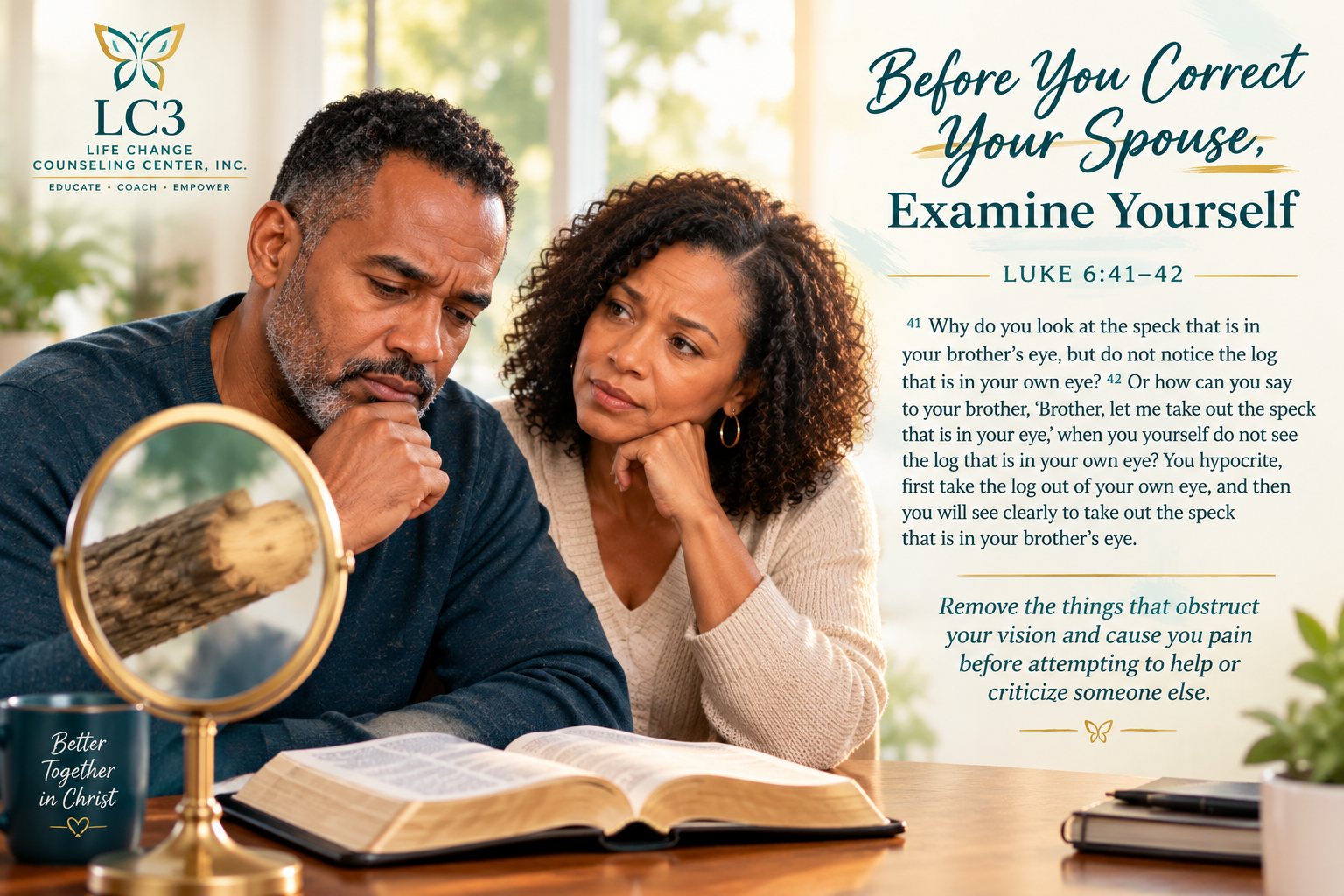
A Christian couple studying Scripture and reflecting on Luke 6:41–42, learning to examine themselves before correcting one another.
Removing the obstacles that impair our vision and hinder healthy relationships
Introduction: What Is Obstructing Your Vision?
In marriage, it is often easier to recognize what is wrong with our spouse than to acknowledge what needs attention in ourselves.
We may quickly identify our spouse's poor communication, impatience, lack of affection, or unwillingness to listen. Yet we may overlook our own defensiveness, resentment, pride, or unresolved emotional pain.
Jesus teaches a profound principle in Luke 6:41–42: before attempting to correct someone else, we must first examine ourselves.
For married and premarital couples, this teaching provides an essential foundation for humility, personal accountability, healthy communication, and lasting relationships.
Scripture: Luke 6:41–42 (NASB95)
Why do you look at the speck that is in your brother’s eye, but do not notice the log that is in your own eye? Or how can you say to your brother, ‘Brother, let me take out the speck that is in your eye,’ when you yourself do not see the log that is in your own eye? You hypocrite, first take the log out of your own eye, and then you will see clearly to take out the speck that is in your brother’s eye.
Observation: The Danger of Impaired Vision
Jesus uses an extraordinary illustration to expose the danger of hypocrisy. A person notices a tiny speck in another person's eye while remaining unaware of a much larger obstruction in their own.
The problem is not necessarily that the other person has no fault. The problem is that the observer's impaired vision prevents them from offering appropriate help.
In relationships, we sometimes recognize the problems and limitations of those around us while remaining unaware of the obstacles in our own lives.
Unresolved hurt, pride, anger, fear, selfishness, and past disappointments can distort our perspectives. These internal obstacles may prevent us from seeing ourselves, our spouses, and our circumstances clearly.
Jesus does not prohibit us from helping others recognize their faults. Instead, He establishes an important order: examine yourself, address your own shortcomings, and then help others with greater clarity and humility.
Application: Remove Your Own Obstructions First
Before criticizing your spouse, consider what might be obstructing your own vision.
Are you allowing past disappointments to influence how you interpret your spouse's behavior? Are you demanding patience while responding impatiently? Are you expecting understanding without making an effort to understand?
Sometimes the very behavior we criticize in others is something we have failed to address in ourselves.
Christ calls us to personal accountability. We must allow God's Word to examine our hearts before using it to correct someone else.
Self-examination does not mean accepting blame for another person's wrongdoing. It means taking responsibility for our own attitudes, choices, and conduct.
When we address what is impairing our vision, we become better prepared to approach others with wisdom, compassion, and understanding.
Marriage Application: Seeing Your Spouse Clearly
Consider a husband who complains that his wife never listens to him. Yet whenever she attempts to express her feelings, he interrupts, becomes defensive, or dismisses her concerns.
Or consider a wife who believes her husband is emotionally distant but has not recognized how repeated criticism may be contributing to tension in their relationship.
Both spouses may have legitimate concerns. However, neither can fully address those concerns without examining their own contributions to the relationship.
The marriage principle
Before asking, "What does my spouse need to change?" ask, "Lord, what do You want to change in me?"
A healthy marriage requires two people who are willing to examine themselves, acknowledge their shortcomings, and pursue growth together.
For Christian couples, marriage provides daily opportunities to practice Christlike humility. Rather than approaching disagreements with the intention of winning an argument, spouses can approach one another with the desire to understand, restore fellowship, and strengthen their covenant relationship.
When both spouses take responsibility for their own conduct, they create an environment where correction is less threatening and reconciliation becomes more attainable.
Importantly, self-examination should never become an excuse for abuse, coercion, or persistent mistreatment. Healthy boundaries and appropriate accountability remain necessary.
Premarital Application: Recognize the Obstacles Before Marriage
Dating and engaged couples have an important opportunity to recognize unhealthy relationship patterns before entering the marriage covenant.
Pay attention to how you respond when your future spouse disagrees with you, disappoints you, or identifies something you need to change.
Are you willing to acknowledge your mistakes? Can you apologize without making excuses? Are you able to receive constructive criticism without retaliating?
Marriage does not automatically remove the emotional obstacles that existed during courtship.
Premarital preparation should therefore involve more than identifying your partner's strengths and weaknesses. It should also include understanding your own communication habits, emotional triggers, family influences, expectations, and areas for personal growth.
Two people who practice humility and accountability before marriage are developing habits that can strengthen their relationship throughout marriage.
Reflection Questions
What unresolved hurt, resentment, or pride may be obstructing my vision?
Am I holding my spouse to standards that I am unwilling to practice myself?
Do I listen to understand, or do I listen primarily to defend myself?
When my spouse identifies a concern, am I willing to consider whether it is valid?
What is one personal change I can make this week that would improve our relationship?
Prayer
Heavenly Father,
Thank You for Your Word, which reveals not only the shortcomings of others but also the condition of our own hearts.
Lord, help us recognize and remove the obstacles that impair our vision. Expose the pride, resentment, selfishness, and unresolved pain that prevent us from seeing ourselves and others clearly.
Teach us to examine ourselves before criticizing our spouses. Give us humility to acknowledge our mistakes, courage to make necessary changes, and wisdom to help one another with love and compassion.
May our marriages and future marriages reflect the character of Jesus Christ. Help us grow together in understanding, patience, forgiveness, and mutual respect.
In the name of our Lord and Savior, Jesus Christ, we pray.
Amen.